



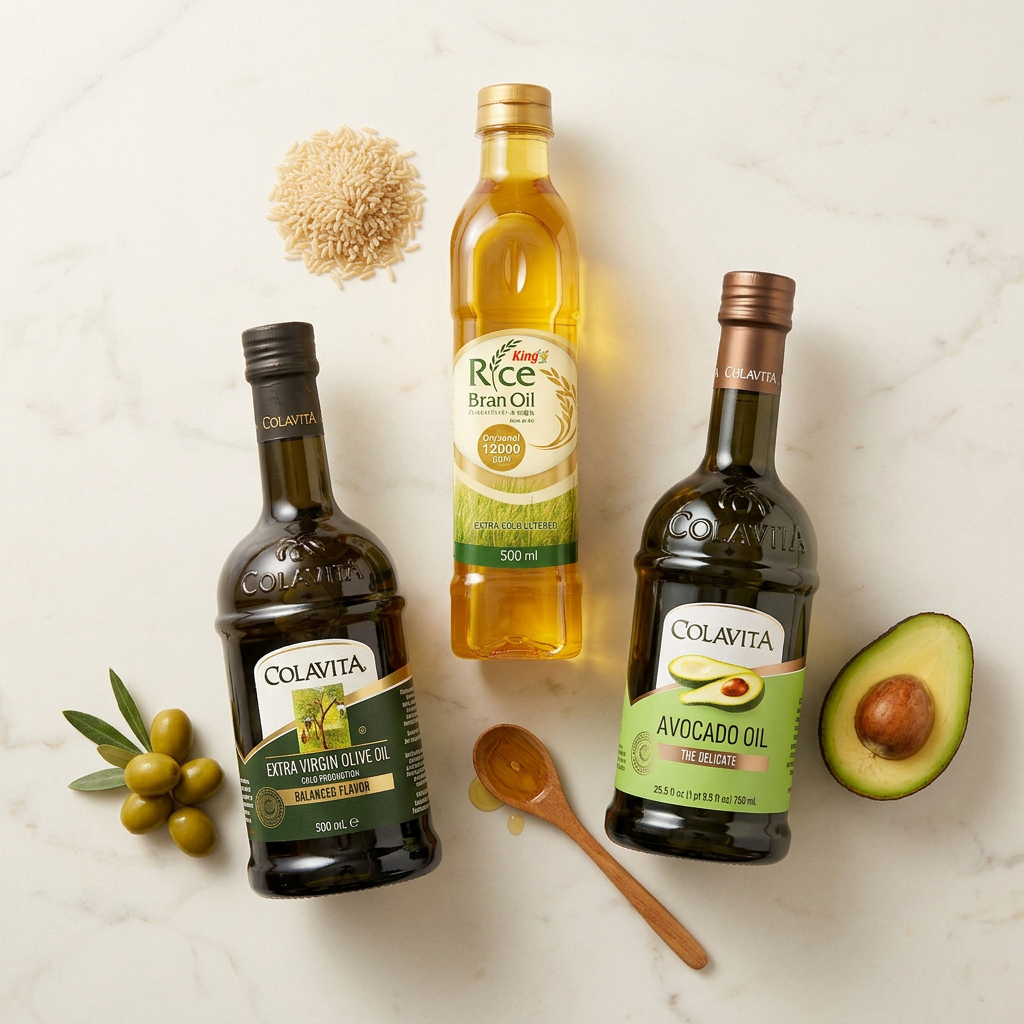
Avocado Oil vs Olive Oil vs Rice Bran Oil: What’s the Difference and Which Should You Use?
Avocado Oil vs Olive Oil vs Rice Bran Oil: What’s the Difference and Which Should You Use? Walk into any supermarket and the cooking oil
Walk into any supermarket and the cooking oil aisle can feel overwhelming. Dozens of bottles, each claiming to be the healthiest option on the shelf. Three names keep coming up for health-conscious cooks: extra virgin olive oil, avocado oil, and rice bran oil.
All three are genuinely good choices. But they’re not interchangeable. Each has a different smoke point, a different flavour profile, and a different set of health strengths. Here’s exactly how they differ and how to choose the right one for what you’re cooking.
The oil you cook with affects more than just taste. Different oils contain different ratios of saturated fats, monounsaturated fats (MUFAs), and polyunsaturated fats (PUFAs). MUFAs and PUFAs are generally heart-healthy as they help improve cholesterol levels and reduce cardiovascular risk. Saturated fats, in excess, can raise LDL (bad) cholesterol.
Beyond fat composition, smoke point matters enormously. Every oil has a temperature threshold beyond which it starts to break down, smoke, and produce harmful compounds. Using the wrong oil at the wrong heat doesn’t just affect flavour; it can compromise the nutritional value of your meal entirely.
Extra virgin olive oil (EVOO) is cold-pressed from whole olives using purely mechanical means, with no heat and no chemical solvents. This minimal processing is what preserves its natural colour, aroma, and beneficial compounds. “Extra virgin” is the highest quality classification, indicating low acidity (under 0.8%) and a flawless taste profile.
EVOO is one of the richest sources of monounsaturated fats, with oleic acid making up around 70 to 75% of its fatty acid composition. It’s also packed with polyphenols, particularly oleocanthal, which has anti-inflammatory properties comparable to ibuprofen, as well as Vitamin E.
A 2024 systematic review and meta-analysis of 33 randomised controlled trials published in the Journal of Nutrition found that EVOO consumption was associated with significant reductions in insulin levels and insulin resistance, reinforcing its role as a heart-healthy dietary fat.
EVOO’s smoke point sits at approximately 190 to 210°C. It handles low-to-medium heat cooking well, including sauteing, pan-frying, and roasting, and remains more stable under moderate heat than most refined vegetable oils. Where it truly excels is unheated: drizzled over salads, pasta, grilled vegetables, or used as a dipping oil. This is when its flavour and antioxidant content shine brightest.
Flavour: Fruity, peppery, slightly grassy. Distinctly present in whatever you’re making, which is a feature, not a flaw.
Avocado oil is pressed from the pulp of ripe avocados, not the seed. Most commercially available avocado oil is refined, which removes impurities, creates a neutral flavour, and dramatically raises its smoke point. Unrefined versions exist but are less common.
Like olive oil, avocado oil is predominantly monounsaturated, with oleic acid making up around 70% of its composition. It’s a good source of Vitamin E and also contains lutein, an antioxidant that supports eye health. Its nutritional profile closely rivals EVOO, making it a strong heart-healthy option in its own right.
Refined avocado oil has the highest smoke point of the three, at approximately 271°C. This makes it the go-to choice for high-heat cooking: deep frying, searing, grilling, wok cooking, and roasting at high temperatures. It’s genuinely stable under intense heat in a way that olive oil simply isn’t.
Flavour: Mild and slightly buttery. Its neutrality means it works well in situations where you don’t want the oil competing with other flavours, such as stir-fries with bold sauces or fried dishes where the oil is purely functional.
Rice bran oil is extracted from the bran and germ layer of brown rice, the most nutritious part of the grain, which is typically removed during white rice milling. It has been a staple in Asian kitchens for decades, and its global profile is growing rapidly.
Rice bran oil contains a healthy balance of monounsaturated (around 45 to 50%) and polyunsaturated fats. But what sets it apart is something none of the other oils can claim: gamma-oryzanol.
Oryzanol is a powerful antioxidant found exclusively in rice bran oil. According to research published in Heliyon (2024), oryzanol is directly related to the inhibition of cholesterol absorption and is used in the management of hyperlipidaemia and menopausal symptoms. It actively lowers LDL cholesterol, maintains HDL (good) cholesterol, and reduces liver cholesterol synthesis. Rice bran oil also contains phytosterols and tocotrienols, a highly potent form of Vitamin E with cholesterol-lowering and antioxidant properties.
King Rice Bran Oil, distributed in Malaysia by Sangla Foods, contains over 2,000 ppm of oryzanol, with a premium high-oryzanol variant exceeding 4,000 ppm. It carries ISO 9001:2015, BRC, Halal, and Kosher certifications and has been awarded heart-friendly status by the Thai Food Good Heart project. The World Health Organization recommends replacing saturated fats with unsaturated plant-based oils, a category where rice bran oil is a strong and well-evidenced choice.
Refined rice bran oil has a smoke point of approximately 232 to 254°C, well-suited for the high-heat demands of everyday Asian cooking. Stir-frying, deep frying, curry cooking, and baking all fall comfortably within its range.
Flavour: Mild with a subtle nutty undertone. It doesn’t impose itself on food, making it ideal for bold Malaysian dishes where the spices and sauces should do the talking.
| Extra Virgin Olive Oil | Avocado Oil | King Rice Bran Oil | |
|---|---|---|---|
| Smoke point | ~190 to 210°C | ~271°C | ~232 to 254°C |
| Main fat type | Monounsaturated (~73%) | Monounsaturated (~70%) | Balanced MUFA + PUFA |
| Unique compound | Polyphenols, oleocanthal | Lutein | Oryzanol (exclusive) |
| Flavour | Fruity, peppery | Mild, buttery | Mild, subtle nuttiness |
| Best for | Raw, dressings, low-medium heat | High-heat, frying, grilling | Everyday cooking, stir-fry, deep fry |
| Price | Mid to high | Highest | Most affordable of the three |
For high-heat cooking such as deep frying, wok cooking, grilling, and searing, avocado oil is the top choice for maximum stability. Rice bran oil is an excellent and more affordable alternative for everyday high-heat Malaysian cooking.
For medium-heat cooking including sauteing, pan-frying, and roasting, all three work well. Olive oil performs admirably here and adds flavour depth. Rice bran oil is the most practical everyday option.
For raw applications like dressings, dipping, and drizzling over finished dishes, EVOO is the clear winner. Its flavour is the point, and its antioxidants are best preserved without heat.
For specific health goals: if anti-inflammatory benefits are the priority, EVOO’s polyphenols are unmatched. For cholesterol management, rice bran oil’s oryzanol offers something the other two simply don’t provide.
For value, rice bran oil delivers the best health-to-price ratio for regular cooking use.
The smartest approach is to keep two oils in your kitchen. Use King Rice Bran Oil as your everyday cooking oil for stir-fries, curries, and frying. Use Colavita EVOO for dressings, pasta, and finishing dishes. That covers every scenario without compromise.
Oils rich in unsaturated fats degrade with exposure to light, heat, and air. Store all three in a cool, dark cupboard away from the stovetop. Dark glass or opaque containers are preferable. Once opened, aim to use within a few months. Rancid oil smells stale or slightly crayon-like; if in doubt, replace it.
For deep frying, avocado oil is the most heat-stable option with a smoke point of around 271°C. King Rice Bran Oil, with a smoke point of 232 to 254°C, is a more practical and affordable choice for everyday Malaysian frying. It handles the heat well and adds no unwanted flavour to food.
Yes, for moderate heat. EVOO has a smoke point of around 190 to 210°C, which is sufficient for sauteing and pan-frying. Research also shows it remains more stable under heat than many refined vegetable oils. For intense high-heat cooking like deep frying or wok cooking, avocado oil or rice bran oil are better suited.
Oryzanol (gamma-oryzanol) is a natural antioxidant compound found exclusively in rice bran oil. It does not exist in olive oil, avocado oil, or other common cooking oils. It works by actively blocking cholesterol absorption in the gut, lowering LDL cholesterol, and supporting overall heart health. It is one of the primary reasons King Rice Bran Oil is recommended for heart-conscious consumers.
Yes. King Rice Bran Oil is Halal-certified, alongside its ISO 9001:2015, BRC, and Kosher certifications.
There’s no single answer, as each oil has different strengths. EVOO leads for anti-inflammatory polyphenols. Rice bran oil is unique for oryzanol and cholesterol management. Avocado oil is the most stable for high-heat cooking. The healthiest approach is to use each oil for the purpose it’s best suited to, rather than relying on one oil for everything.
You can, but it is the most expensive of the three and its neutral flavour means you won’t gain the taste benefits of olive oil or the unique antioxidants of rice bran oil. For everyday Malaysian cooking including stir-fries, curries, and fried rice, King Rice Bran Oil is a more practical and cost-effective choice with comparable heat performance.
Colavita Extra Virgin Olive Oil and King Rice Bran Oil are available in Malaysia through Sangla Foods Sdn Bhd, distributed to supermarkets and grocery chains across Peninsula and East Malaysia.
Avocado Oil vs Olive Oil vs Rice Bran Oil: What’s the Difference and Which Should You Use? Walk into any supermarket and the cooking oil
Recent studies show a growing interest in plant-based milk among most health-conscious Malaysians. This diet is becoming popular as it brings sustainability and health benefits
Elevate Your Nespresso Experience in Malaysia The Nespresso machine has become a staple in many Malaysian homes, offering a quick and consistent way to enjoy
In recent years, Malaysia has seen a shift towards plant-based diets, making plant-based beverages a popular alternative to dairy. Health-conscious consumers appreciate its health benefits